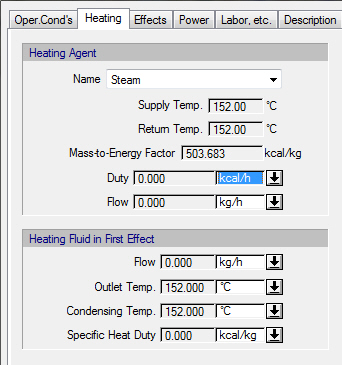
Multi-Effect Evaporation: Heating Tab

ContEvaporationMEEHeating.jpg

This tab appears on the interface dialog of the Continuous Multi-Effect Evaporation operation if the Vapor Recompression Option is set to “None” in the Oper. Conds Tab (see Multi-Effect Evaporation: Oper. Conds Tab).

Variable Definitions, Ranges and Default Values

The following table shows a brief description of the variables appearing in this tab; for a detailed description of these variables, see Multi-Effect Evaporation: Description of Terms The table also displays their default values and their generally acceptable range. Note that due to how the variables are used in the modeling equations, the range of acceptable values may be further reduced; for more details, see Multi-Effect Evaporation: Modeling Assumptions & Constraints.

Variable

Default Value

Range


Steam Input Stream Name
The name of the stream that is connected to the input port for steam.

<none>

Dedicated Input Port

Heating Agent Name
Indicates the heating agent used in the evaporator. Click on the list box to bring up a list of available heating agents in order to select one.

Steam

Any Heating Agent

Supply Temp. of Heating Agent (oC)
The temperature at which the heating agent is supplied from the utility plant to the evaporator.

152.0

Positive

Return Temp. of Heating Agent (oC)
The temperature at which the condensed heating agent returns to the utility plant from the evaporator.

152.0

Positive

Mass-to-Energy Factor of Heating Agent (kcal/kg)
The specific heat source of the heating agent between the supply and return points.

503.683

Positive

Flow of Heating Agent (kg/h)
The mass flow rate of the heating agent.

0.0

Positive

Duty of Heating Agent (kcal/h)
The heat transfer rate of the heating agent.

0.0

Positive

Flow of Steam in Heating Space of First Effect (kg/h)
The mass flow rate of the steam in the heating space of the first effect. If a heating agent is used to represent the inlet steam (i.e., the “Use Heating Agent” option is selected), this is the same as the mass flow rate of the heating agent.

0.0

Positive

Saturation Temp. of Steam in Heating Space of First Effect (oC)
The saturation temperature of steam at the assumed steam pressure in the heating space of the first effect. If a heating agent having equal supply and return temperatures is used to represent the inlet steam (i.e., the “Use Heating Agent” option is selected), the saturation temperature of steam in the heating space of the first effect matches the heating agent’s supply or return temperature.

152.0

[Supply Temp., Return Temp.]

Outlet Temp. of Steam from Heating Space of First Effect (oC)
The temperature of condensed steam leaving the heating space of the first effect. If a heating agent is used to represent the steam in the heating space of the first effect (i.e., the “Use Heating Agent” option is selected), the outlet temperature of steam from the heating space of the first effect matches the heating agent’s return temperature.

152.0

Positive

Specific Heat Duty of Steam in Heating Space of First Effect (kcal/kg)
The specific heat transfer rate of steam in the heating space of the first effect (the difference between the specific enthalpy of steam at the heating space inlet and the specific enthalpy of steam at the heating space outlet). If a heating agent is used to represent the steam in the heating space of the first effect (i.e., the “Use Heating Agent” option is selected), the specific heat duty of steam is the same as the heating agent’s mass-to-energy factor.

0.0

Positive

Symbol Key: User-specified value (always input); Calculated value (always output); Sometimes input, sometimes output

Specification Choices / Comments

For more details on how the available specification choices in this tab are implemented, see Multi-Effect Evaporation: Modeling Calculations.