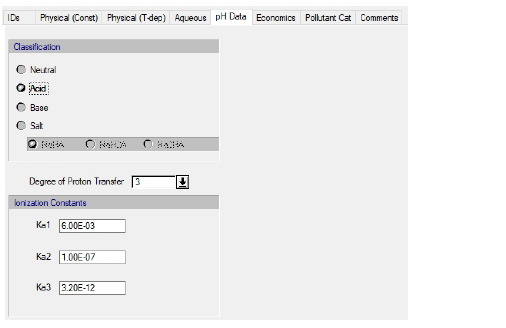
This tab is part of the Pure Component Properties Dialog.
Chemical substances are commonly classified into acids, bases, salts, and neutral compounds according to their behavior in aqueous solution. Acids are substances that can donate protons (H⁺) or increase the concentration of hydrogen ions in water, such as HCl or H2SO4. Bases are substances that accept protons or release hydroxide ions (OH⁻) in solution, like NaOH or Ca(OH)2. When an acid reacts with a base, the products are typically a salt and water; salts are ionic compounds composed of the cation of a base and the anion of an acid (e.g., NaCl, K2SO4). Substances that are neither acidic nor basic and do not dissociate significantly in water, such as sugars or alcohols, are considered neutral compounds. This classification provides the foundation for the pH calculation in streams and procedure states.
|
|
SuperPro can account for the contribution of ampholyte salts to the pH. Ampholyte salts comprise ions that can act both as acids and bases. Their behavior in solution depends on the relative strengths of their acidic and basic groups, quantified by their acid dissociation constants (Ka) and base dissociation constants (Kb). For example, monosodium hydrogen phosphate (NaH2PO4) can donate a proton from the H2PO4⁻ ion, with a tendency described by its Ka, or accept a proton to form H3PO4, with a tendency described by its Kb. The net behavior of an ampholyte salt depends on the ratio of Ka to Kb . This dual capacity makes ampholyte salts effective buffering agents, capable of resisting pH changes within a certain range. |
The degree of proton transfers describes the number of protons (H⁺ ions) an acid can donate or a base can accept in an aqueous solution. Acids are classified as monoprotic when they can donate a single proton per molecule (e.g., HCl, HNO₃), diprotic when they can donate two (e.g., H2SO4, H2CO3), and triprotic when they can donate three (e.g., H3PO4). Similarly, bases may be described by the number of protons they can accept or the number of hydroxide ions they release, such as NaOH (monoprotic base) or Ca(OH)2 (diprotic base). The degree of proton transfer is therefore a structural property of acids and bases, independent of their strength, and it provides important insight into how many steps of ionization a substance can undergo during acid–base reactions.
The ionization constant measures how readily an acid or a base dissociates in water. A high ionization constant indicates a strong acid or base, meaning most of its molecules break apart into ions, while a low ionization constant corresponds to a weak acid or base that only partially ionizes. These constants provide a quantitative way to compare the strengths of different acids and bases and are essential for predicting the pH of solutions, understanding equilibrium in acid–base reactions, and designing neutralization processes..
|
|
To denote a strong acid (or base) specify a Ka (or Kb) value equal to 1000. |
|
|
The pH data tab is visible only if the “Show pH of Streams and Pure Component pH Data” option has been enabled from the Miscellaneous preferences of the document. |


